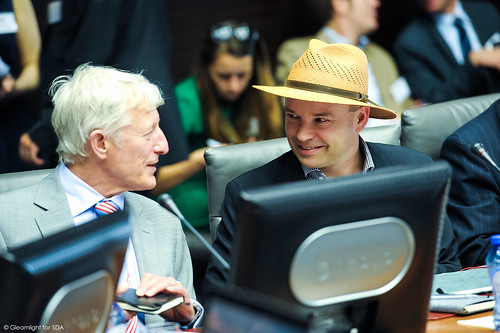
“I have no power at all. The only thing I can do is talk, bring ideas in, smile at people, be kind, be empathic, and prove that empathy is possible. Yeah, that’s all I can do. But that works. That has a big effect—a much bigger effect.” These are the words of Wuppertal-based silent diplomat Andreu Ginestet, who possesses a decade of experience in the field of silent diplomacy. Since August 2020, he and his colleagues have been making arrangements to take charge of a negotiation aimed at achieving nuclear disarmament. He has written several essays, including “1962 Cuba Missile Crisis and War in Ukraine—McNamara Lessons” and the manuscript of the book PAX in German. In addition to being a silent diplomat, he is a native speaker of Catalan, German, English, French, and Spanish, and a sculptor and photographer. Ginestet responded to the questions about Russian President Putin’s condoning of two cannibals who enlisted in the war in Ukraine (Rai, Independent, Nov. 24 2023), the repercussions of the Ukraine-Russia war on Ukrainian culture, and silent diplomacy. Excerpts.
Özelgün: I would like to start with a recent event. According to Independent, Putin administration has condoned two cannibals, Denis Gorin and Nikolai Ogolobyak, who enlisted in the war in Ukraine (Rai, Independent, Nov. 24 2023). How do you think this decision affects the sense of justice in Russia?
Ginestet: It is putting the world upside down. It implies that if there was ever a democracy in Russia, or, let’s say, the hope of democratic development, this kind of decision would jeopardize any hope of having a society that could trust its government. Because if you put cannibals, who are notorious murderers or Satanists in the streets, you first allow them to go to the front to do a battle where they can commit atrocities, and they can enjoy the atrocities, and they do enjoy the atrocities! It’s like, you know, these people are monsters. There are enough records, for example, of the torturers in Indonesia, well, and there were torture camps also in Cambodia. And every time you talk to torturers, they really enjoy what they do; it’s pure sadism. They are deeply satisfied with sadistic approaches. To pardon them is a very strange, horrendous, terrific, and really cruel way of dealing with the civil population, because you are threatening your own civil population with this kind of person. You cannot reintegrate them into society. It doesn’t work. So for this reason, I would say that if you want to do wrong, this is the best way to show it.
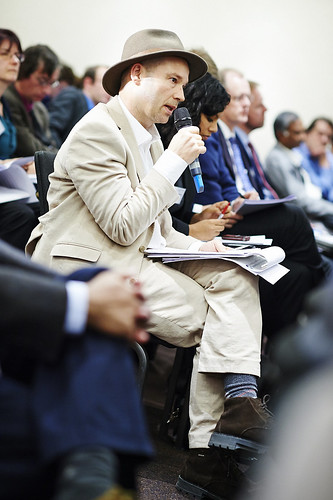
Özelgün: You state in your article “Intelligence and EQ” that “What I found out is that a war erases the visible structure of a culture and society by erasing buildings, books, etc.” (Ginestet, 2012; 1). What might be the concrete implications of this statement in the Ukrainian context?
Ginestet: The erasing of a culture happens through fragmentation. The destruction is not total destruction. So what happens to that country is that it gets fragmented, and, let’s say, a possible culture can emerge from the fragments. This is something that happens to human bodies as well. Human bodies are not destroyed; they are fragmented, and then something new is born out of them. So this perspective is, let’s say, a more conciliatory perspective regarding the future of Ukraine, because we don’t want to damn Ukraine to be a destroyed country. Then the next issue is that obviously it is erasing the footprints of a culture, but still, Ukrainian culture is a resilient culture. There are Ukrainian artists who are working with us here in Wuppertal-North Rhine-Westphalia. They are working on peace issues. So, our group is based on solidarity with Ukrainian artists, and we discuss with them, for example, the future of Ukraine in terms of peace. It’s a discussion that needs to be done, and the destruction of this culture may obviously be the intention of the Russian side.
Özelgün: You made reference to Ukrainian artists who resisted the war’s devastating effects. Could you please exemplify them more?
Ginestet: These artists are painters, and one of them is a classical painter, Oksana Tytenko. She uses a lot of human figures in her paintings. Tytenko and we artists are exhibiting right now in a small gallery, which is called the PHİLOPART in Wuppertal. She makes very beautiful, loving, comforting, and caring pictures. So she depicts empathy. And the other artist is Irina Synkevich who does more landscapes and flowers, but Oksana also does flowers. I think that it’s very normal that when you come out of a war, you start depicting those things that bring you back into life, like flowers, which are always symbols of hope and renewal. And Irina Synkevich draws and paints many pictures with one type of flower, poppies. Poppies are often used as a symbol in painting, symbolizing fallen soldiers or killed soldiers. So she does a lot of paintings with poppy flowers. This kind of work is not only beautiful, sensitive, and warm, but it also reminds us of the reality of the situation in Ukraine right now.
Özelgün: Does the presence of a ceasefire between the conflicting parties without a peace accord necessarily indicate the presence of peace?
Ginestet: No, it doesn’t. It doesn’t at all. It’s an open conflict that has not been closed as required and requested by the Russian side since 1990 without interruption, and even before, since 1948 without interruption. It’s like, the Russians always asked for respect and a fair reciprocal treatment, and everybody should remember that. For example, according to the Swedish International Peace Research Institute (SIPRI), strange things happen. Starting 2017 you see Russia as the only country on planet Earth reducing armament production (SIPRI Fact Sheet December 2021, THE SIPRI TOP 100 ARMS‑PRODUCING AND MILITARY SERVICES COMPANIES, 2020), which is a very strange thing, isn’t it? If you plan to go to war with Ukraine, how come, three years before you go to war, you reduce your armament production? This is published by German online papers and scientific institutes in Munich (ISW sozial-ökologische Wirtschaftsforschung e.V.: SIPRI: Russische Rüstungsfirmen gegen den Trend. Sie müssen auf zivile Güter umstellen.). Question is, if the Russians operate towards disarmament, why is the USA doing the opposite, not following the same path?
Özelgün: But what I have been observing is that Russia, under the leadership of Putin, has an aggressive policy, although the country has been reducing its arsenal. What’s more, its arsenal is large enough for aggression. This was proved in the occupation of Abkhazia, South Ossetia, and Crimea. Last but not least, Russia is acting as a Big Brother, not respecting the international relations and independence of other sovereign countries like Ukraine and Georgia.
Ginestet: Yes, agreed, 100%. We are in fact happy that Russia is not as strong as the USA, because we probably would have worse conflicts. But, if the big boss on planet Earth, the USA, behaves himself like a rascal, then the second big boss in the world, Russia, will do the same, because this is a very male, masculine, white, masculine, old man’s fashion attitude. In Putin’s words: “Biden is an irritating person. I’ll be too”. It’s very simple: the American Congress publishes how many wars the US started and in how many wars they were involved since 1990. And I think it’s about 10 to 34 times more than Russia (depending on the accounts). The USA waged 251 military interventions abroad since 1990, versus 8 to 15 Russian military interventions abroad during the same period (both numbers according to Wikipedia) or 25 cases according to the RAND corporation (and I suppose there is no need to mention what the RAND corporation is).
Özelgün: But then we find ourselves in a dead-end. For me, the thing that had better be addressed and criticized is the realist school of international relations and Realpolitik. There’s a structural failure in the realist school’s reading of international relations. I can be a wrongdoer as USA, but this does not legitimize the wrongdoings of Russia. At this juncture, I would like to talk about silent diplomacy…
Ginestet: The politics of raw power, brutality or force, Realism in political science prevail because few countries seek power over cooperation. No tyranny has any legitimacy. The use of violence is outdated, it is a reminiscence of the past, an atavism. We Silent Diplomats condemn any use of force as illegitimate. Silent diplomacy acts out of empathy, soft power and avoids power positions. Silent diplomacy seeks conciliation. Silent diplomacy is about being in the room. It is not only about curing the trauma and discussing a situation that has gone wrong; silent diplomacy is above all about prevention, which implies that you have an idea on how to fashion the world. With this idea, you go into the room and talk about this idea of peace with the people in the room, and that has an effect—a long-term effect. So it’s like there are two discussions that run in parallel. One discussion is about the immediate conflict, but in parallel with the present talk, a background discussion runs about the construction and architecture of peace. So, silent diplomacy is very efficient because it uses soft power. Silent diplomacy works ahead of conflicts, and we have been working nonstop, even though I did my sabbatical and didn’t go to the sessions between 2020 and 2023. I haven’t been back to Brussels, but I am writing, and it’s not me alone: it’s a team! And what we write is about new perspectives and new ideas on how a peace settlement could be established in the future. What we write is utopian. When I say utopian, I mean it in real political terms. In realism terms, a utopian approach implies that it can be done in the next five years. It’s utopian because it has not yet happened and gets so close to reality that it could be done, and it’s what could be done that is being discussed right now.
Özelgün: If we consider the concept of silent diplomacy in the context of the current war…
Ginestet: This implies that in the situation itself, obviously the first talk must be done with the Ukrainians, who are the first victims of this war, and by this I don’t mean the military and the government. I mean the people; I mean the citizens, which is a process. So this is a technique: to include the population in the discussion. This is something we know it can be dealt with, for example, with the methods of Augusto Boal, who was a Brazilian theatre practitioner, drama theorist, and political activist, published by the UN. But you know, I must be invited, I need permission, I need legitimacy, and peace must be wanted. So, for the moment being I would state: No, there is no option to, for example, discuss with the Ukrainian population the conditions of the terms of peace as long as realism policies persist and prevail.
Photo Credits
1- The Featured Image
Photo Size: Medium 500 (500 × 333) Gleamlight for SDA
Security and Defence Agenda’s Photostream (Uploaded on May 27, 2012 Taken on May 27, 2012). After Chicago: Re-evaluating NATO’s priorities – participants
License History
Date May 27, 2012 at 8:00:07 PM GMT+2
Original License Attribution (CC BY 2.0)
2- The Second Image
Photo Size: Medium 500 (333 × 500)
Friends of Europe’s Photostream 2013-01-21-foe-0184 (Uploaded on January 22, 2013 Taken on January 21, 2013)
License History
Date January 22, 2013 at 3:17:53 PM GMT+1
Original License Attribution (CC BY 2.0)
References
Ginestet, Andreu. (2012). Intelligence and EQ. https://www.academia.edu/1255352/2010_2011_2012_Intelligence_and_EQ_Andreu_Ginestet
Rai, Arpan. (24 Nov. 2023). Putin pardons two cannibals who joined Russia’s war in Ukraine – report. https://www.independent.co.uk/news/world/europe/putin-pardons-cannibals-russia-war-ukraine-b2452758.html


 Weltschau
Leave a comment