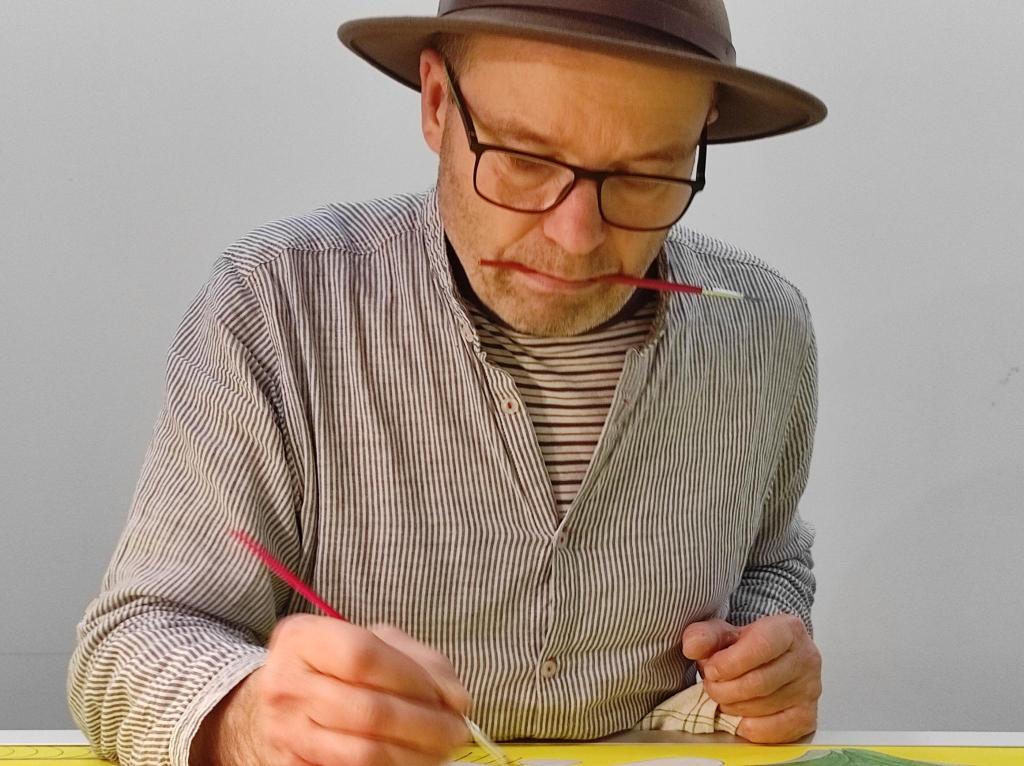
“To take the harshness out of words, diplomacy is discrete. But even discrete words can be too much when it comes to the tangible and delicate interests of two or more states. And that is why there is so-called ‘silent diplomacy’ as one of the diplomatic instruments” (Weibel, 2008). These are the statements of Thomas Weibel, a Journalist of the SRF2 in Switzerland. Today we write about such a Silent diplomat, Andreu Ginestet, headquartered in Wuppertal who has ten years of expertise in the field of silent diplomacy and who, since August 2020, together with his colleagues has been making preparations to take charge of a negotiation aspiring to accomplish i.e. nuclear disarmament (Ginestet 2018). However, he is also a sculptor, in addition to being a silent diplomat. The predominant genre in his body of work is social sculpture. Therefore, his initial public assignment, Elan (1986-1998), takes the form of a social sculpture. According to him, vigour symbolically represents the liberation of humanity. Conversely, disassociation from violence is discussed in easily understandable written works about the sculpture. The artist who thinks that social sculptures send messages into the future told me how art can defy President V. Putin’s hybrid war scheme in Ukraine and, when asked, what kind of sculpture he would make to symbolise Ukrainians’ war experiences and peace when the war ends. Excerpts.
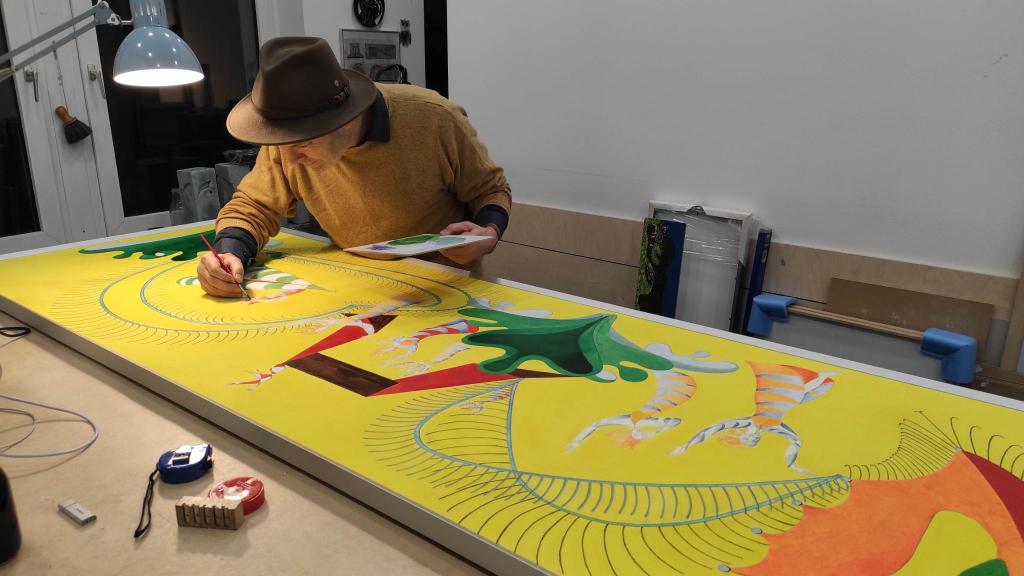
ÖZELGÜN: You are a sculptor and photographer. How can sculpture and photography counter Russia’s hybrid war strategy in Ukraine?
GINESTET: One of the classical examples which has been applied already in all war scenarios is that, for example, giant pictures of babies, toddlers, or playing children are situated on the roof of a building or are put on the facade of a building so that i.e. the Russians know: “here are people living. This is not a combat space. We are civilians; spare us.” It has worked in the past. This method was applied, for example, in Syria. It helped then and there. However, the point is that we now have a different type of war.The war is getting more and more crazy, which implies it’s turning more and more into a hybrid war by all means and all senses. The civilian population is being targeted, even though this is a no-go in terms of warfare. So facing this, the only answer possible, which would be constructive, is healing and building up self-confidence. No heroism, no heroic figures, no boasting. There is already enough boasting in the field.
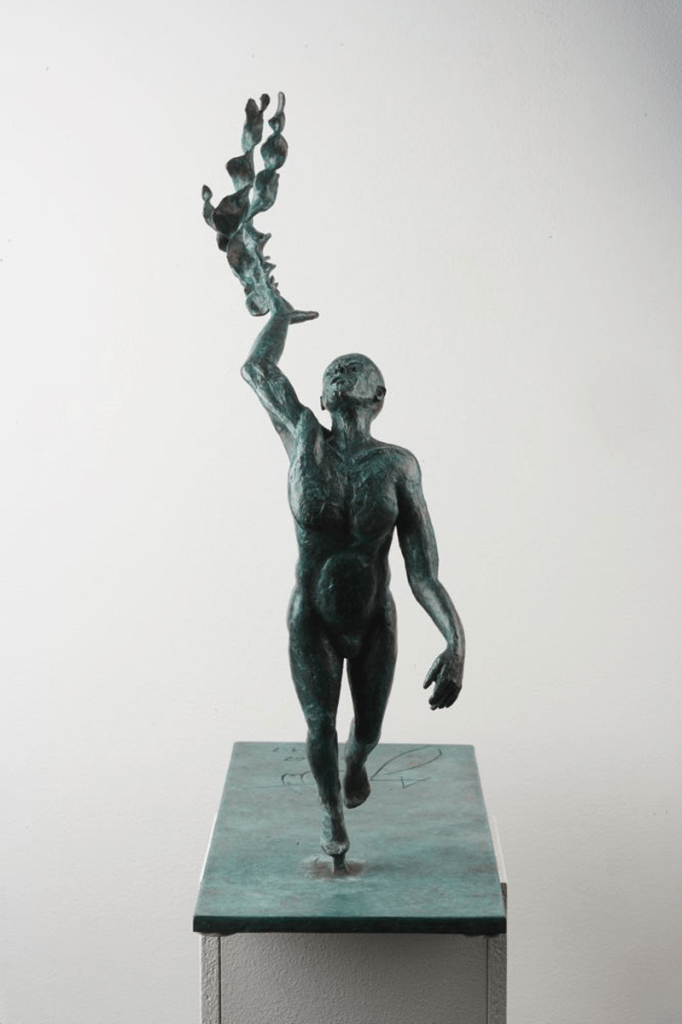
Atleta Vital 2007 – Bronze Casting 1
ÖZELGÜN: Concretely speaking…
GINESTET: I’ve been facing the system of violence since 1998. This is when I became aware of the fact that violence is a system. It’s an independent system, and the enemy of humankind. It is like a virus. Albeit it is completely an abstract entity that causes a problem and trouble, it has very direct and very concrete consequences because in a war, people suffer. They get mutilated when they walk on a mine or when they are hit by a bullet. So my answer is ambiguous because I also have to adapt to this vague reality, which implies that I have a method, which is empathic, which is concrete, which is derived from my photography or from my painting, which is producing happiness, beauty, warmth, and sensitivity. But on the other hand, as an artist, I have to embed it in a larger discourse. So, for example, if you hang a picture of a toddler in a building, knowing what is happening for instance in Gaza or Ukraine, what effect will it have? Is it going to hold the Israeli or Russian army back once it sees a baby on a building? It may have some effect on the single soldier, but not on the army chief, who is in command and who is asking his soldier to kill. So he would say, “Get over it, shoot, destroy the image, and whatever is behind it”. So right now, at this moment, those elements that worked in the past will not necessarily work anymore, which implies that we can still use the picture of a painted baby on a building or on a roof. But adapting to hybrid warfare, it would have to be positive empathic art, beautiful art that is healing art, plus some extra activity like a theatre play that is played with the general public immediately in the situation.
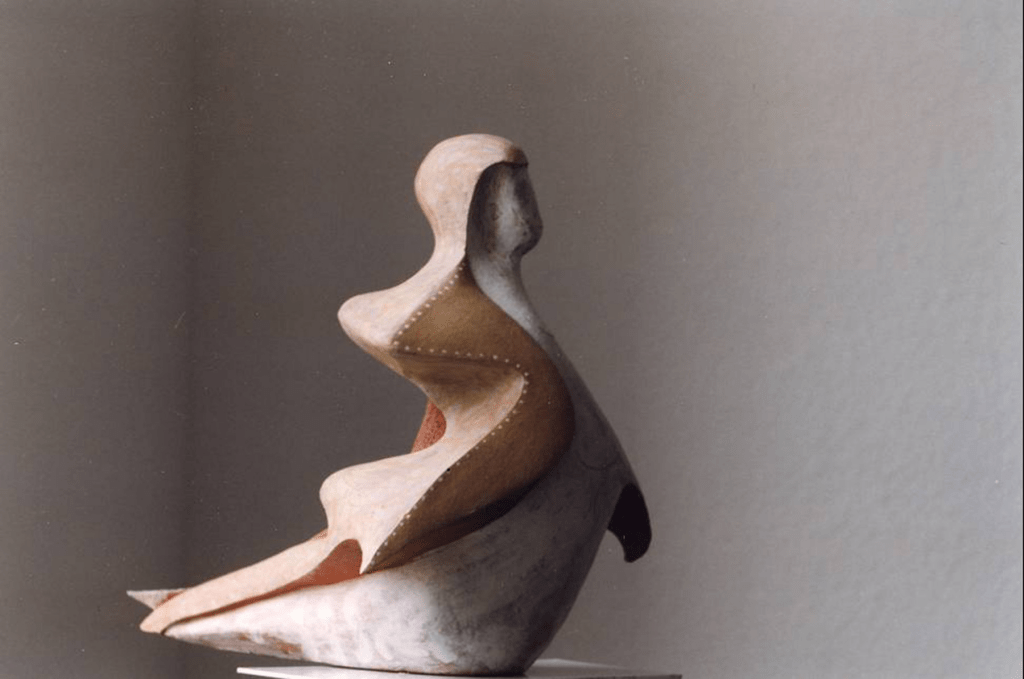
Anmut 1998 – Ceramic painted with Elden
ÖZELGÜN: If you were asked to make a sculpture in Ukraine that symbolizes people’s war experiences and peace when the war ends, what sculpture would you make and why?
GINESTET: I would make a sculpture that gives people a hint about the continuation of humankind, which implies that at least three to four generations come into play in the sculpture. So it would be, for example, something like the Citizens of Calais by French sculptor A. Rodin, but integrating four generations because at least the next 10 generations will now be implied in the Ukraine war. It will take maybe five, maybe 10, maybe 15 generations before these people can say: “we have overcome the trauma of this war”. Right now, they don’t even feel that they are traumatised because they are in a fighting mode. They forget about what it is like to live a normal life. But when the war ends, they will then face the memories and the trauma, because somebody in the family has been lost and the home has been destroyed for whatever reason. So there are many issues that contribute to working with trauma. And this implies that they need a long perspective. So I could imagine, for example, producing a sculpture where even the symbols of the foetus, or the sperm, and the ovule are dignified, like showing there is life that is not even generated but that will come. So it’s like we must elongate the perspective of the future. In social sciences terms, it’s called elongating the shadows of the future, so bringing the future into the present.
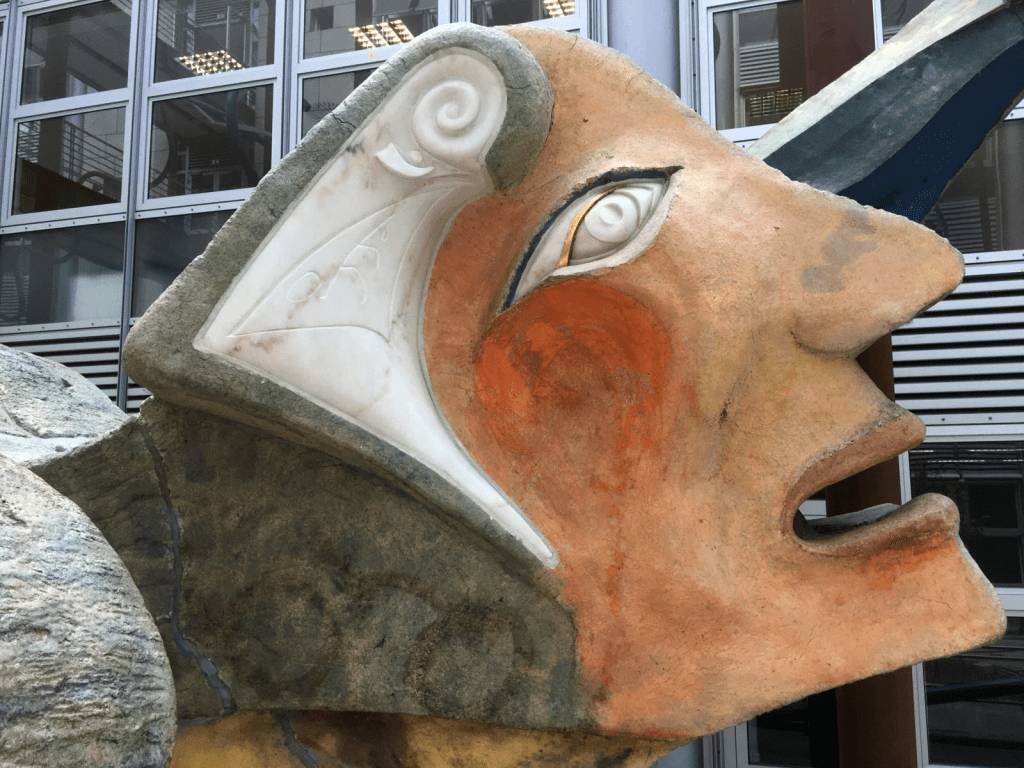
Elan – Marble inlays in ceramics and gilding
ÖZELGÜN: You are also a photographer. If you had the opportunity to visit Ukraine right now, where would you like to photograph and why?
GINESTET: What I really would like to photograph is the children, the children, the children, and the children again because this war is being done at the expense of these children. Although the adults suffer a lot, the children’s lives are being jeopardised, completely destroyed, and disrupted. So we must focus on what needs the focus most. I would show the children in the most humane way possible. If, for, let’s say, four weeks, we did erase all the pictures of adults out of all media and would just see children in all media, I would like to know how the minds of people would change.
ÖZELGÜN: In the war, the animals are also suffering and almost no one represents them. We all are the children of Gaia…
GINESTET: You’re right in the sense of Gaia. But it’s not just that. I was talking to a Ukrainian friend of mine who is a painter. She was completely frightened. She was telling me that in Ukraine, they’re thinking of passing a new law. Accordingly, all the woods can be cut down quickly. Because it’s better to cut down the trees now and use the wood and sell it than to have the Russians destroy it. It implies that they can cut down all the trees. They can leave the country bare-naked according to this law if it is passed. I don’t know if the law has been passed or not. But I just remember how this painter came up to me and told me this. So it’s completely crazy. So yes, a war is, let’s say, the exacerbation of the system of violence that destroys life. It puts an end to life as we know it. And there is always one profiteer, one animal form. It’s i.e. bacteria. They eat our corpses away. It’s the micro level. So, in a war it’s like it’s micro against macro. The small biology is winning over the big and intelligent biology because the bacteria are the ones making profit from our stupidity. So with this regard, what I would do is create giant images of bacteria that eat away human corpses and animals that are dead on the field, or those bacteria that survive in woods when the trees have been cut down. So that people get aware of what is there. People need to know more and more about what is going to be alive after humans and after the Anthropocene. But it will take millions of years to recover back the diversity and beauty it still has now. We certainly will not be there to appreciate what is coming. So in this war, the way animals die is not the equivalent of how humans die. But they are very closely related and very tied to each other. Life is a network, and we cannot eliminate components of the network and still think that the network will thrive. It will not. Killing the major animals in Ukraine is as problematic as cutting down all the woods. It implies total destruction of life as we know it, and it implies obviously accelerating climate change, etc.
Photo Credits
1- Featured Image: Copyright by © Andreu Ginestet & Benito Barajas & Wolfgang Kraft & Federico C. Gobartt. Permission granted by Andreu Ginestet.
2- The second image: Copyright by © Andreu Ginestet & Benito Barajas & Wolfgang Kraft & Federico C. Gobartt. Permission granted by Andreu Ginestet.
3- The third image: Copyright by © Andreu Ginestet & Benito Barajas & Wolfgang Kraft & Federico C. Gobartt. Permission granted by Andreu Ginestet.
4- The fourth image: Copyright by © Andreu Ginestet & Benito Barajas & Wolfgang Kraft & Federico C. Gobartt. Permission granted by Andreu Ginestet.
5- The fifth image: Copyright by © Andreu Ginestet & Benito Barajas & Wolfgang Kraft & Federico C. Gobartt. Permission granted by Andreu Ginestet.
References


 Weltschau
Leave a comment