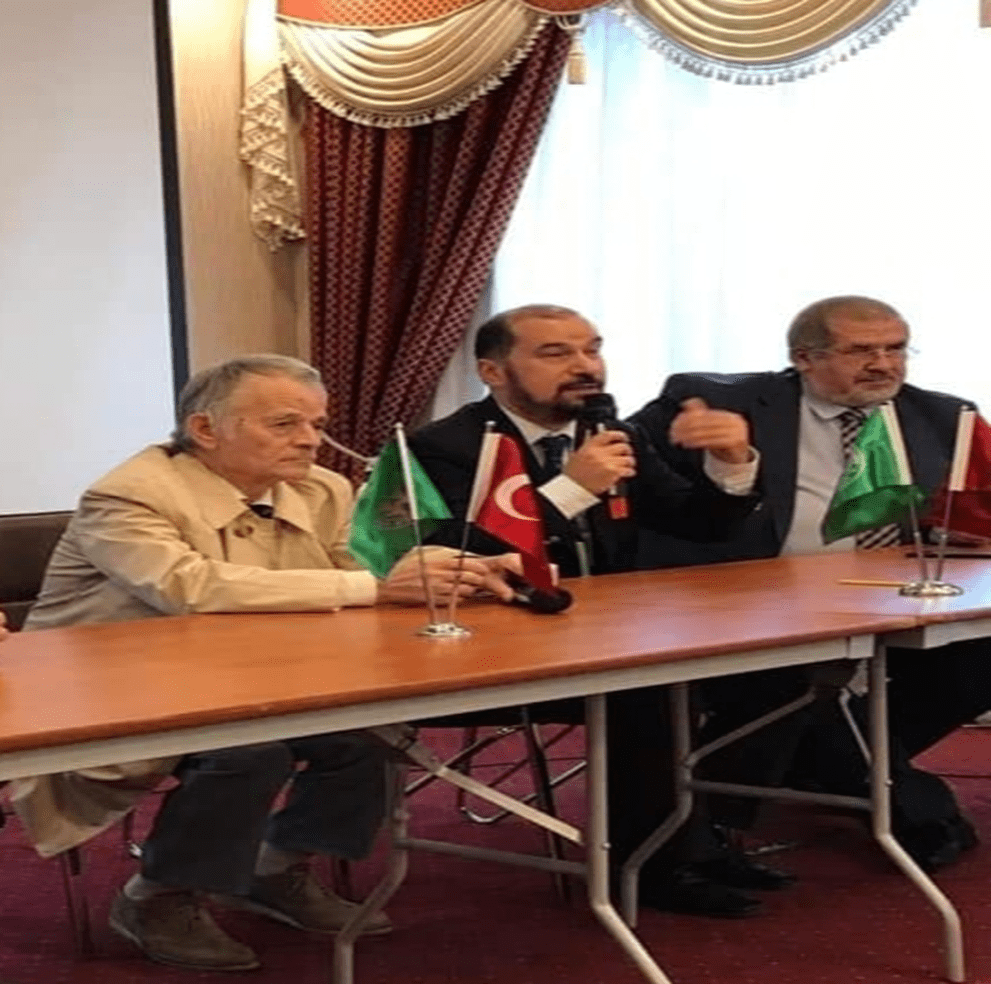
“War also comes with laws. We demonstrated this at the Battle of Gallipoli (1915–1916), for instance. During times of war, fundamental human rights and necessities, such as healthcare and food, are ensured. Unfortunately, Russia, under the leadership of President V. Putin, did not demonstrate an adherence to the laws of war during this process” (QHA, 2023). Prof. Dr. Enver Aydoğan, a panel participant discussing the Ukraine-Russia War and the fate of Crimea, emphasised that there are constraints on the policies and actions of states in times of war with these remarks. I asked questions to Aydoğan, who touched upon the aspiration Moscow wants to achieve—”Soviet plans and goals resurfaced with Putin” (QHA, 2023)— in his speech at the panel and who also chairs the Inspection Board of the World Crimean Tatar Congress, about freedom of religion and freedom of expression in occupied Crimea and in what ways Russia is violating the law of war in the context of the occupation.
ÖZELGÜN: What was the impact of Russia’s occupation of Crimea on the demographic composition of the region?
AYDOĞAN: First of all, in order to understand Russia’s fundamental desire for the occupation of Crimea, it is necessary to go back to the year 1783. Until the year 1783, Crimea was a part of the Ottoman Empire territory, and in that year, under the reign of Empress Catherine II of Russia, Crimea was seized through coercion and turmoil. Following the seizure, Crimean Tatars and Muslim populations living in Crimea either faced massacres or were forcibly expelled from the Crimean Peninsula. Subsequently, policies aimed at the russification of the Crimean Peninsula rapidly continued, particularly after the Crimean War between 1852 and 1856. There was a growing trend of forced migration of Crimean Tatars in the Crimea Peninsula during this period, along with increasing repression.
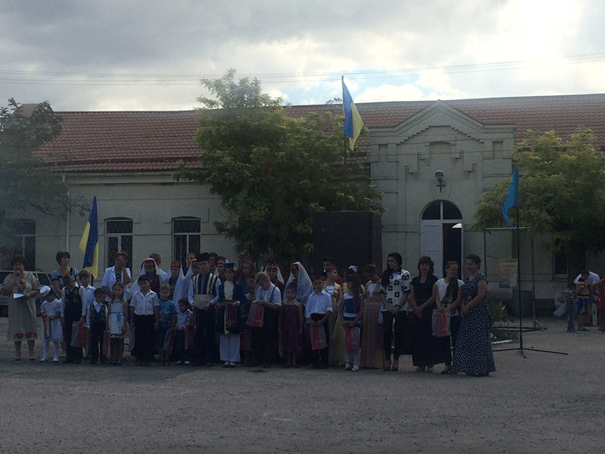
From a ceremony held in Genicesk-Kherson prior to the Russian invasion
ÖZELGÜN: By the early 1900s…
AYDOĞAN: When we look at the Crimea Peninsula, we can observe that the population of Crimean Tatars was higher compared to Russians and ethnically Ukrainians. Finally, on May 18, 1944, the cruel policy of Stalin emerged, not only targeting Crimean Tatars but also other Caucasian peoples and ethnically Ukrainians, with a forced migration policy and, concurrently, perpetrating a genocide, marking the culmination of a systematic depopulation policy aimed at Crimean Tatars.
ÖZELGÜN: As the century nears its conclusion…
AYDOĞAN: By the time we reached 1986–1987, as a result of Russia’s Glasnost and Perestroika policies, efforts were made within the Soviet Socialist Republics to grant some democratic rights to certain populations. Consequently, in 1991, especially those Crimean Tatars who were deported to the Urals, Siberia, Uzbekistan, and Central Asia, were able to return to Crimea, reclaiming their homeland. During the period leading up to Russia’s reoccupation of Crimea in 2014, it is estimated that approximately 15% to 20% of the population in the Crimean Peninsula consisted of Crimean Tatars and Muslims. Especially considering the demographic composition of the Crimean Peninsula, we know that ethnic Russians constitute the majority. Secondly, we have information that Ukrainians constitute a significant portion of the ethnic composition. However, geographically speaking, the sensitivity of the region led to the last census being conducted in 2000, and it’s known that there hasn’t been a census since then. Furthermore, based on historical documents and considering the basic human rights conventions of the United Nations (UN), it is recognized as a reality that the Crimean Peninsula is the homeland of Crimean Tatars, the indigenous and ancient people. Additionally, even though it’s known that after 1991, Crimean Tatars were allowed to return to the Crimean Peninsula, during the Soviet era, there was a resettlement policy around the Crimean Peninsula as part of the Soviet Union’s policy, aimed at those who desired to reach Crimea out of longing for their homeland. It’s evident that, particularly regarding settlements where Crimean Tatars predominantly resided, there was a clear preference for returning to their homeland.
ÖZELGÜN: The current situation…
AYDOĞAN: Especially within the framework of the reoccupation of Crimea by Russia in 2014, as a policy of the current Russian Federation, it is known that the russification policy has increased in the region, as evidenced by the many homes forcibly taken from Crimean Tatars and various settlement policies aimed at ethnic Russians. It is evident that, sometimes, lands in Crimea, which are milder and more fertile compared to Siberia and have access to the sea, are presented as attractive to Russians, and sometimes, economic support is provided, leading to an increase in russification policies over approximately an eight-year period. Therefore, within today’s context, it’s apparent that Russia’s policies aimed at increasing its presence in Crimea historically continue, and because of these policies, it is known that there are still ongoing efforts to decrease the demographic population of Crimean Tatars and Ukrainians within the Crimean Peninsula.
ÖZELGÜN: Is it possible to talk about freedom of religion and freedom of expression in occupied Crimea?
AYDOĞAN: After the occupation of the Crimean Peninsula by Russia in 2014, we are witnessing serious human rights violations and, at the same time, issues arising regarding the freedom to practice religious beliefs. Sometimes, particularly when considering individuals under the age of 18, we are confronted with many incidents where deterrent actions and escalating human rights violations are observed. One of the fundamental reasons for this escalation is related to Russia’s traditional policies aimed at increasing Russification and the dominance of Orthodox Christian faith, particularly the increasing activities aimed at the eradication of Muslim Tatar identity within the Crimean Peninsula. Especially, the historical mosque area in the Bahçesaray, which is significant for the Crimean Khanate, and many mosques built and opened after 1991 within the Crimean Peninsula, faced obstacles to worship and, sometimes, were closed on very simple grounds, such as the absence of a congregation, following the reoccupation of the Crimean Peninsula by Russians in 2014.
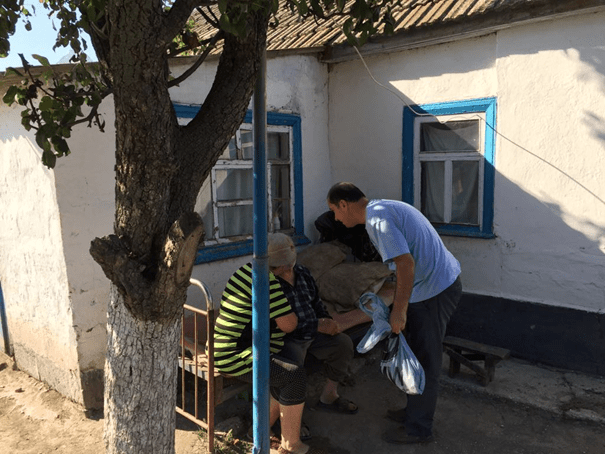
House visit for Eid al-Adha in Novoolesiyevka-Kherson prior to the Russian occupation.
ÖZELGÜN: What barriers exist in the way of education?
AYDOĞAN: As part of the same fundamental issue, we can comfortably say that we face many obstacles in the curriculum of primary schools, middle schools, and high schools regarding the teaching of Crimean Tatar language and the instruction of Islam within their belief system. Those who oppose this situation, especially Crimean Tatars and some ethnic Ukrainians, are unjustly imprisoned under various pretexts, such as treason and disrupting social order. Many of them are reported to have been abducted or subjected to extrajudicial killings, with their bodies found in vacant lots around cities and districts, a fact that has been reported by international news agencies and reflected in international courts as of today. Therefore, it can be said that living on the Crimean Peninsula after 2014 has truly become a torment, resembling an open prison. The practices that prevent people from living according to their basic beliefs and values, particularly due to their restrictive and oppressive nature, have placed the Muslim Tatar population in a significantly disadvantaged position in the region. The arrest of Neriman Celal, deputy chairman of the Crimean Tatar National Assembly, along with some other Crimean Tatars, on unjustifiable grounds, and their sentencing to long years of imprisonment, symbolizing a show of force over Crimean Tatars, characterized by suppressive, coercive, deterrent, and even human rights violations, are very strong evidence that, following the occupation of the Crimean Peninsula in 2014, neither freedom of expression nor the ability to freely practice religious beliefs is possible.
ÖZELGÜN: In what ways is Russia violating the law of war in the context of the occupation?
AYDOĞAN: Both the occupation of Crimea in 2014 and the attempted invasion of Ukraine initiated in February 2022 by cruel Russia have no justifiable grounds. In this process, which emerged as an extreme threat to the future of independent democratic and self-determining peoples, violating international law, we witness numerous examples of Russia’s occupier and oppressive policies, especially within the framework of occupation policies, targeting indigenous and ancient peoples, as well as innocent children, women, the elderly, and individuals who express an intention to surrender within the context of war. On one hand, many of us are aware of the resistance demonstrations against the occupation demonstrated by the Crimean Tatar National Assembly’s will and opposition policy during Crimea’s occupation process in 2014. Likewise, we are aware of the declarations of patriotic ethnic Russians advocating for the integrity of Crimea as part of Ukraine’s territory. However, it is a reality that none of the policies against this occupation, whether by Crimean Tatars or patriotic ethnic Russians, have been considered by Russia.
ÖZELGÜN: The concrete actions taken by Russia within the scope of the occupation…
AYDOĞAN: The first decision taken by the occupier Russia Federation against the Crimean Tatar National Assembly during the occupation of Crimea in 2014 was to ban and label it as a terrorist organization. Entry to the Crimean Peninsula was banned for all officials holding positions in the Crimean Tatar National Assembly, and later, this ban was extended for life. As of today, it is no longer possible for Mustafa Abdülcemil Kırımoğlu, Rıfat Çubar, and other members of the Crimean Tatar National Assembly to enter the Crimean Peninsula based on decisions made by Russia. Furthermore, it is a known reality that pressure and persecution against Crimean Tatars in the region have increased. Arrests, abductions, human rights violations resulting in beatings, injuries, and even fatal cases of murder are increasing. The homes of Crimean Tatars are occupied without any valid excuse, especially, and they are brought to trial based on fabricated evidence, leading to convictions in court and even lifelong imprisonment.
ÖZELGÜN: On the Ukrainian mainland…
AYDOĞAN: We also witnessed the killer Russia’s policies during the invasion of mainland Ukraine in February 2022. Especially, none of us have forgotten the massacres in Bucha that occurred around Kiev. Among the population in the region, we have witnessed killings, rapes, and restrictions on the most basic human rights such as nutrition and the freedom to live, especially for children, women, and the elderly who lived in peace and tranquility in Ukraine. Unfortunately, similar situations have occurred in mainland Ukraine following the February 2022 occupation, particularly in the eastern territories of Ukraine. In this context, the Donetsk region stands as an example. Moreover, reports indicate ongoing violations of human rights and the rule of law in the Kherson region, where policies continue to deviate from the reality that life is the most basic human right under UN conventions. These policies have almost turned into an ethnic cleansing, as clearly outlined in reports by international observers, aiming at both de-Tatarization and de-Ukrainianization in the region. Therefore, while historically, we know many realities indicating Russia’s non-compliance with international law and its violation of the laws of war, in the 21st century, we witness Russia’s occupations stripping people of democracy, human rights, freedom, and thus, their most basic freedoms.
ÖZELGÜN: You mentioned Kherson. What is the significance of the Kherson region and what motivates Putin’s strong desire to invade it?
AYDOĞAN: The Kherson region, known as the sole connection of the Crimean Peninsula to the mainland of Ukraine, is strategically very significant. Especially after the occupation of the Crimean Peninsula by Russia, it is widely assumed that the Chongar Gate, through which the connection between the Crimean Peninsula and the Ukrainian mainland is maintained, holds crucial importance. On one hand, the region’s border with the Black Sea and its proximity to the Sea of Azov enhance its significance. Another important aspect is that Kherson is a region where ethnic Tatars reside, and, following Stalin’s invasion in 1944, it became home to the Ahıska Turks, who wanted to return to the Caucasus but were victimized by resettlement policies at that time. Therefore, when we consider the geopolitical position of the Kherson region, it becomes evident that it serves as the only land route connecting the Crimean Peninsula to the Ukrainian mainland, surrounded by the Black Sea and the Sea of Azov. Hence, the strong persistence of policies aimed at the continued occupation of the region, especially by Putin, underscores the geopolitical importance of the region and the reality of Ukraine’s mainland being disconnected from the Crimean Peninsula. Furthermore, we can state that the Kherson region is crucial for meeting the water needs of the Crimean Peninsula, making it the most significant area in this regard. Additionally, considering energy resources, it is known that Kherson plays an important role in meeting the energy needs of the Crimean Peninsula, making the region’s occupation by Russia an extremely strategic decision. Therefore, the occupation of the Kherson region by Russia is a decision of utmost strategic importance, considering its role as the main land connection to Crimea, its significance in meeting Crimea’s water and energy needs, and its geopolitical implications for Ukraine’s territorial integrity.
References


 Weltschau
Leave a comment