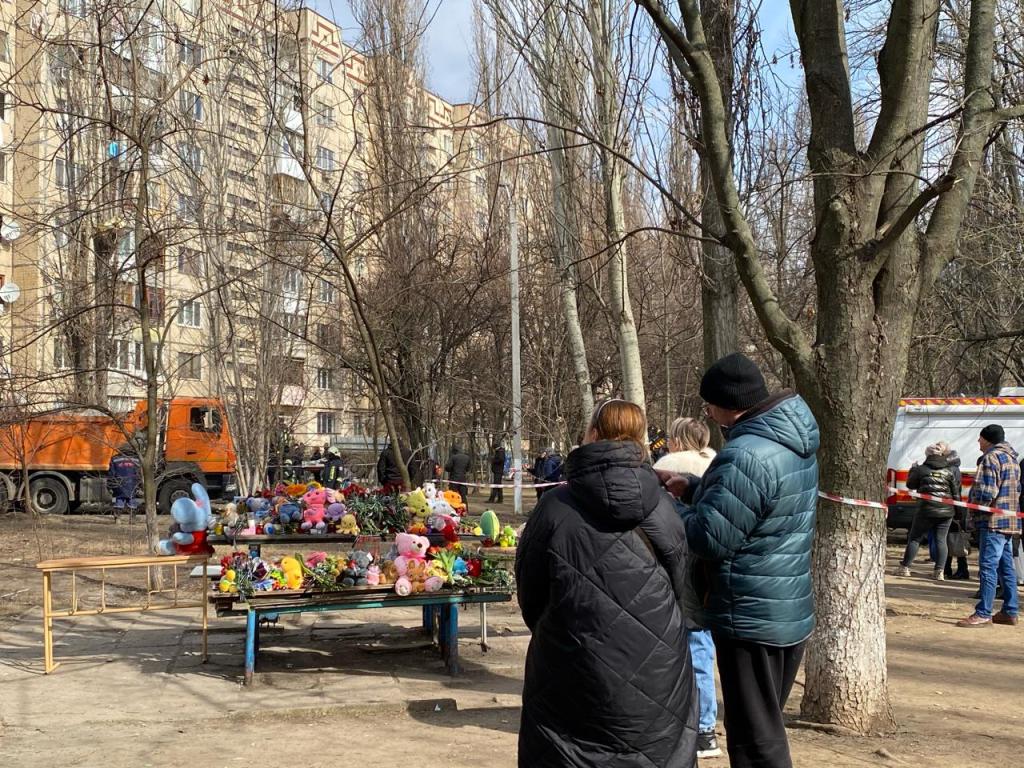
At night, trucks roll past my high-rise building in one of Odesa’s residential districts. These trucks are fully loaded with construction waste, concrete fragments, windows, furniture, broken glass, and pieces of people’s lives. The sirens of police cars and ambulances are wailing. In the morning, black bags are added to the scene, reserved for those who lost their lives.
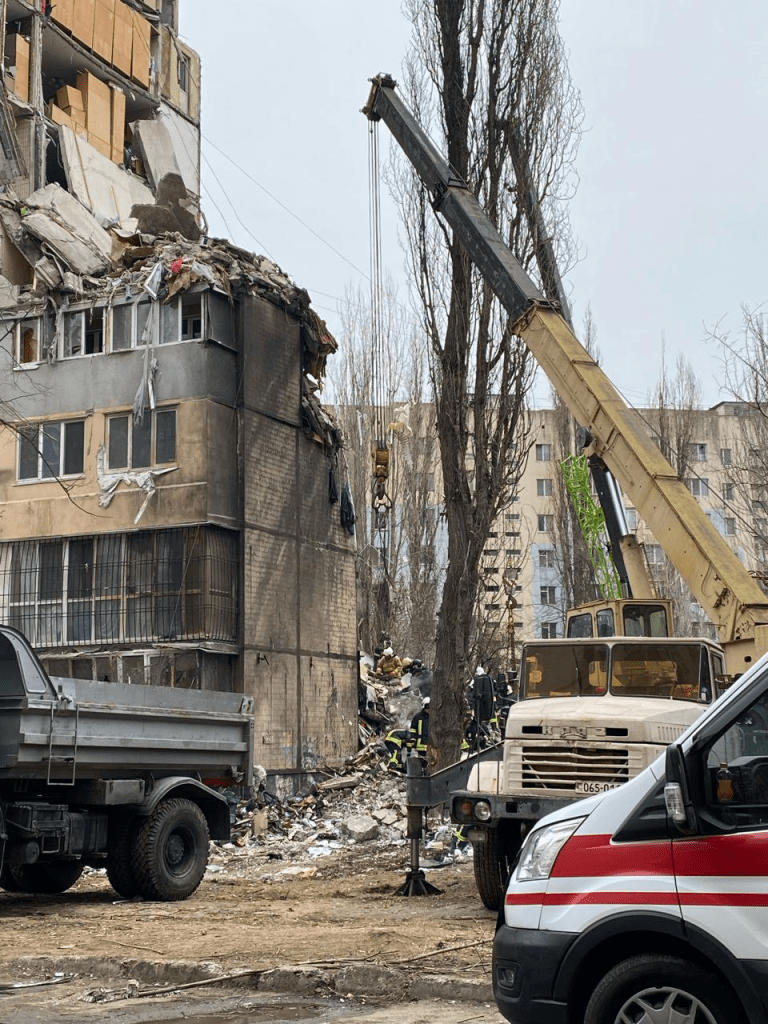
Photo Credit: Yevhenia Henova
On the night of March 2, as we celebrated the beginning of spring in 2024, Russian invaders struck Odesa with unmanned aerial vehicles packed with powerful explosives. One of the drones hit a nine-story building in a densely populated area, demolishing the top six floors of one of the sections. Rescuers have worked tirelessly throughout the night and day, and as I write this, they continue their efforts to reach everyone who found their eternal rest under the shattered building.
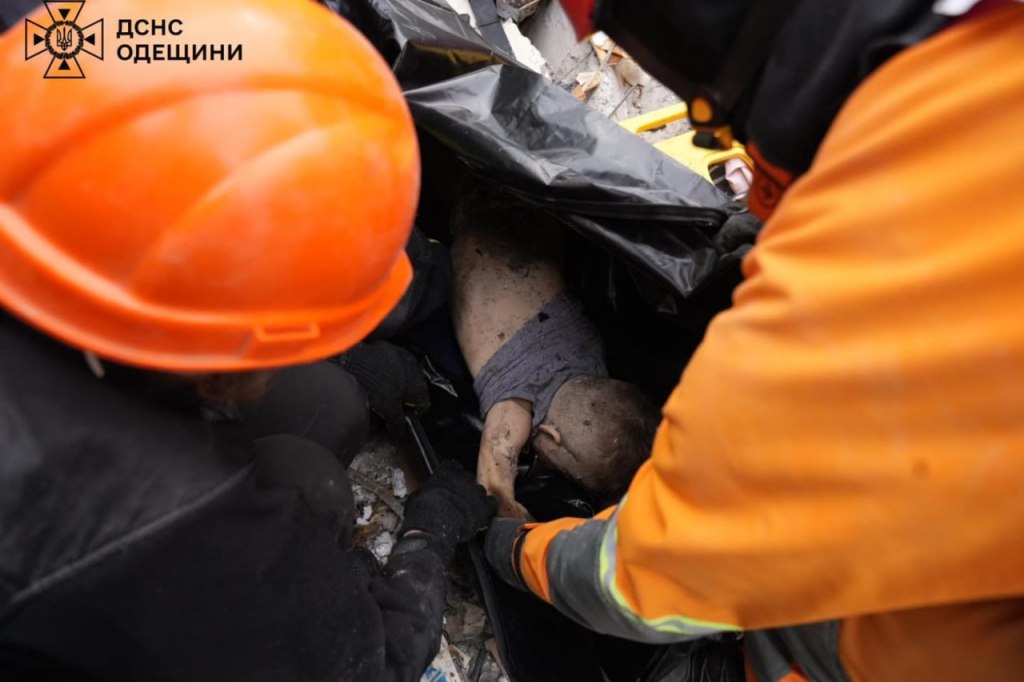
Photo Credit: Search-and-rescue service of Odesa
The search dogs, having found another body, lie down exhausted on top of the slabs. Their handlers mention that when a dog doesn’t find any living people, only the deceased, it falls into a sort of canine depression. I cannot verify this, but it seems plausible.
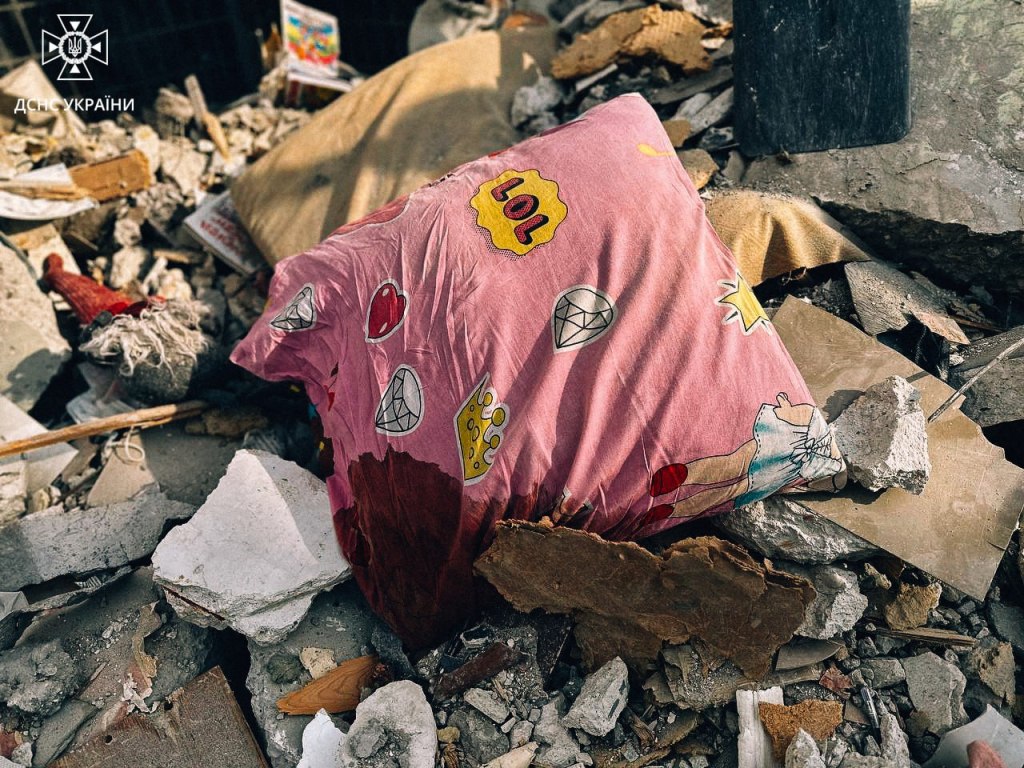
Photo Credit: Search-and-rescue service of Odesa
Residents from neighbouring blocks keep bringing food, water, hot tea, and warm blankets for the rescuers. They also carry flowers and toys for the victims, creating a makeshift memorial. One older man brought a pot filled with traditional Ukrainian borsch and burst into tears. He questioned those around him, asking why God let him, an old man, live while the little children in that building perished. No one had an answer.
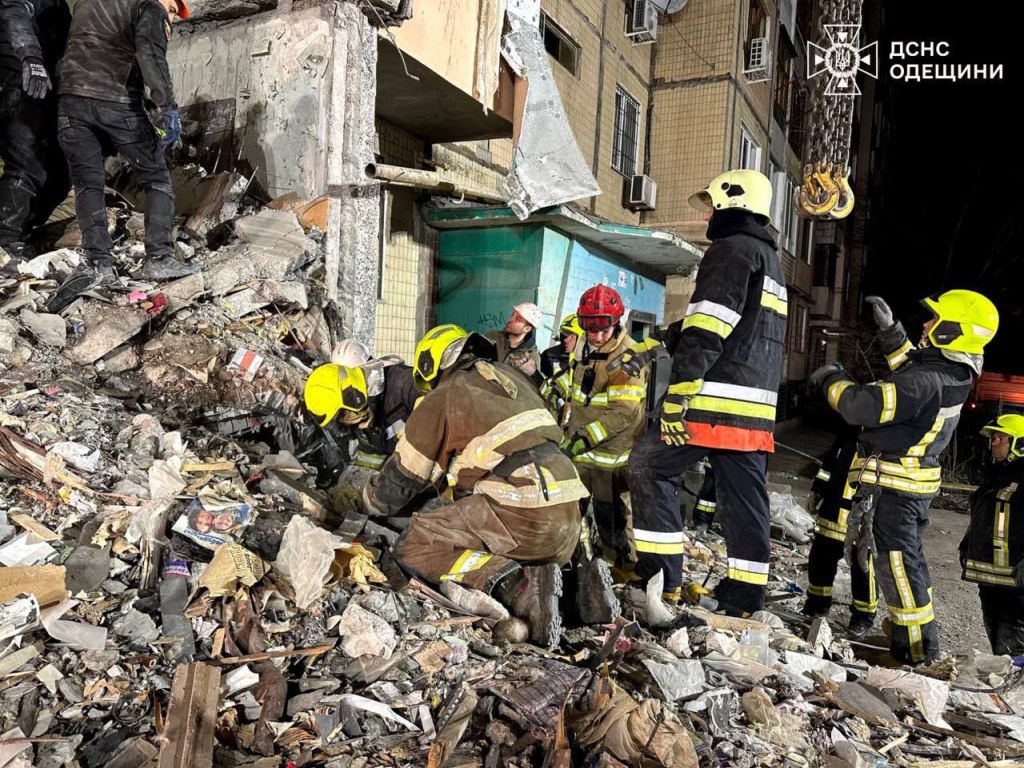
Photo Credit: Search-and-rescue service of Odesa
A small, cosy coffee shop nearby features a beautifully decorated space. Spring colours and delicate flowers dominate the scene, with windows showcasing exquisitely adorned cakes and pastries. The barista has red eyes, and everyone knows why. People quietly buy coffee and biscuits for the children, leaving swiftly. Many of them carry bouquets with an even number of flowers tied with black ribbons—a customary offering for graves in Ukraine.
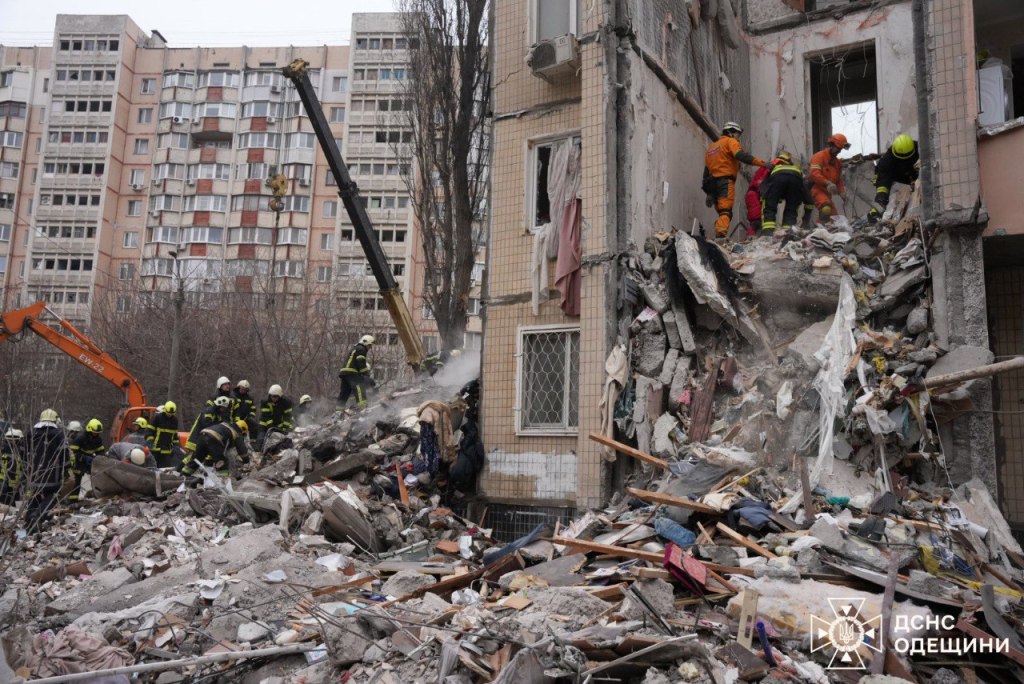
Photo Credit: Search-and-rescue service of Odesa
Hanna worked as a designer at this coffee shop. The last Instagram post she shared featured a photo of the space she had decorated and a greeting to the beginning of spring. She was among the first to be found, embracing her four-month-old son in bed. Her husband and older daughter survived as they were sleeping in another room, a bit further from the drone strike.
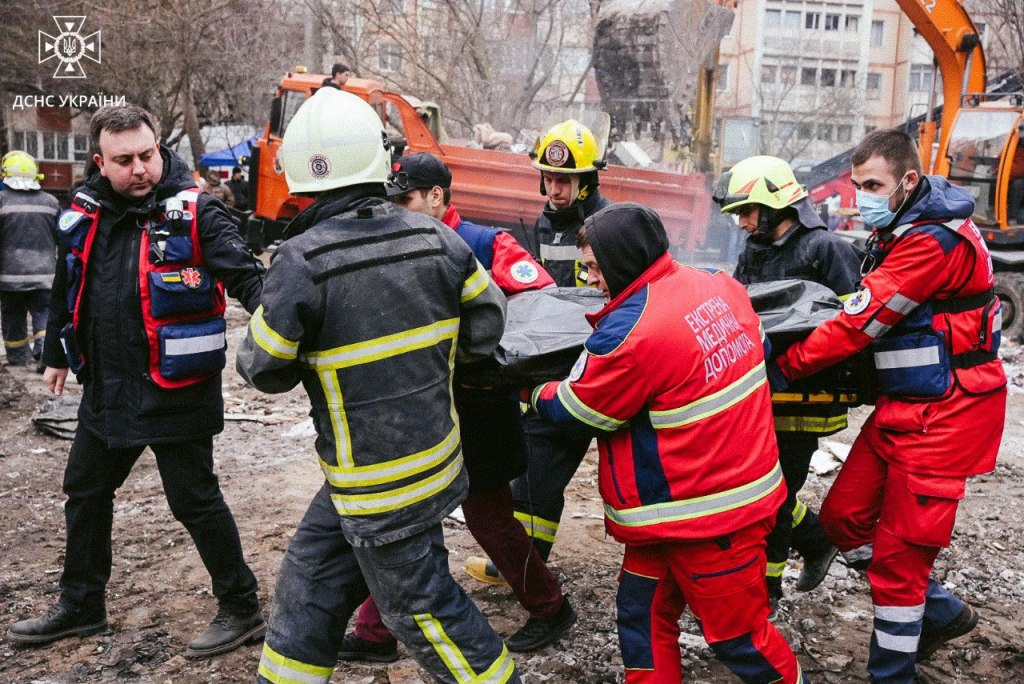
Photo Credit: Search-and-rescue service of Odesa
Rescuers are carefully retrieving another body, that of three-year-old Mark. His father was also killed in the attack, and Odesa doctors are battling for his mother’s life. She is not yet aware that her family has perished.
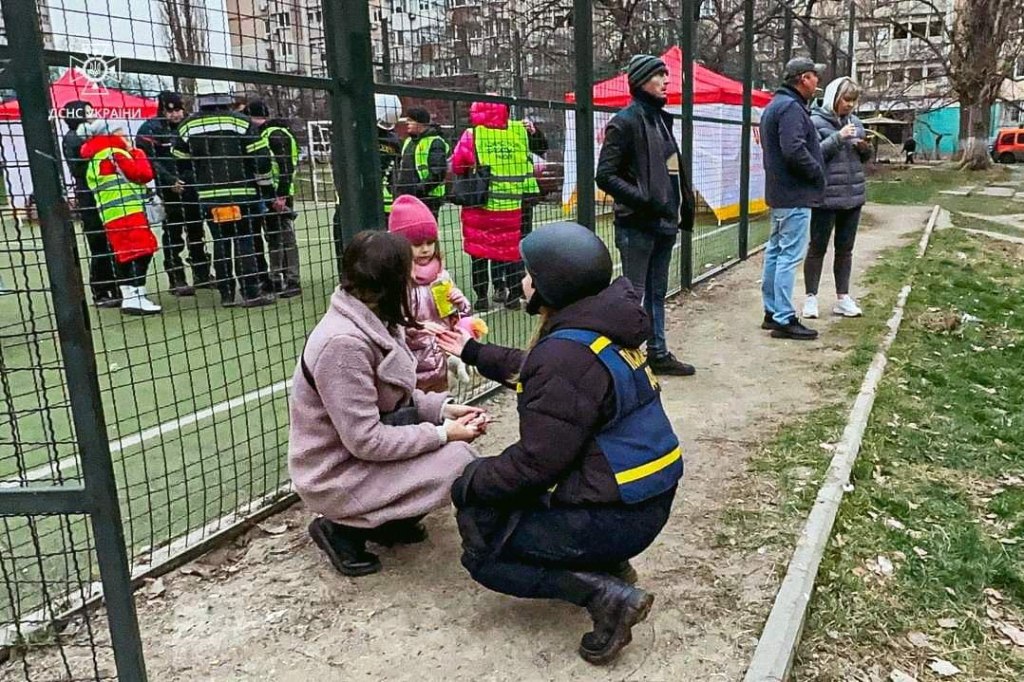
Photo Credit: Search-and-rescue service of Odesa
The following day, March 3, brings news of another devastating family tragedy: rescuers extract the body of a woman embracing her baby from beneath the concrete. Nearby is her husband’s body. This is the family of Tetiana and Oleh, and their seven-month-old daughter Yelizaveta. Two other children from this family, aged eight and nine, would be discovered later in the evening.
On the morning of March 3, when we gather to pay respects to the victims, a siren goes off over the city once again—the Russian military has fired a missile from the Black Sea at our region. Everyone stands in front of the building in silence, frozen, listening to the hum of generators, the noise of a construction crane persistently digging through the rubble in the hope of finding someone alive, and the wail of the siren. At times, some of us glance up at the sky, either checking for a deadly missile or seeking answers to our questions.
It is the most significant tragedy in Odesa since February 24, 2022, when the Russian Federation initiated a full-scale war against Ukraine. According to initial reports, twelve individuals, including four children, lost their lives in this residential building. Regrettably, this was not an isolated incident. As per estimates from law enforcement and civil society activists documenting Russian war crimes, over fifty people perished and several hundred sustained injuries in Odesa, a million-strong city on the Black Sea, from February 24, 2022, to March 2024. The region witnessed even higher numbers of casualties and injuries. Numerous buildings, including the seaport, religious structures, and more than fifty nineteenth-century architectural landmarks, were destroyed. Odesa and the region’s ports, agricultural infrastructure, grain storage facilities, and tourist amenities also suffered severe damage. The list of destroyed facilities in Odesa and the region spans several pages, and the list of the destroyed human lives is unlikely to be encapsulated in any printed text.
The Russians shell the city and the region every week, often multiple times a week and occasionally more than once a day. They deploy attack drones, referred to as “Geranium” by the Russians but identified by the Ukrainian Defence Forces as Iranian Shahed-136 UAVs. Cruise missiles are launched from tactical and strategic aircraft, and Onyx missiles are launched at Odesa from the occupied Crimea. The Russian authorities openly acknowledge that Odesa, despite enduring relentless shelling and destruction, remains a target for occupation. In February 2014, Dmitry Medvedev, the Deputy Chairman of the Security Council and former President of Russia, stated, “Odesa, come home. We have been waiting for Odesa in the Russian Federation.”
For this narrative, the Russian authorities propagate a self-created myth asserting that Odesa is purportedly a Russian city – a claim that, of course, is untrue, akin to the numerous falsehoods about Ukraine that Russian propaganda has sought to impose for many years. This is primarily targeted at our country’s foreign partners, aiming to strip us of their genuine support. In May of this year, Odesa will commemorate the 609th anniversary of the first documented mention of a settlement that once occupied the territory now known as Odesa. Originally called Kochubey, the town underwent name changes: first to Khadzhibey, and finally, Odesa in 1795, following the Russian Empire’s conquest of this Black Sea territory.
Kochubey gained historical recognition as a thriving seaport engaged in grain trade with Byzantium in 1415. It was documented in the authoritative work “History of Poland” by the chronicler Jan Długosz. Over three hundred years later, in September 1789, the Russian army overtook the Khadzhibey fortress, prompting the city’s renaming to Odesa. Since its inception, this port city has been multinational, home to Nogais, Greeks, Genoese, Turks, Moldovans, Poles, Armenians, Jews, Ukrainians, and representatives of dozens, if not a hundred, of ethnic groups. As such, the city weaves together the histories of different peoples, encompassing their cultures, religions, cultural heritage, trade routes, and, of course, business interests.
In the 21st century, Odesa stands as a port city with a well-developed trade and tourism infrastructure, benefiting from a favourable geographical location. The destruction of this significant port would pave the way for the Russian Federation to annex a portion of Moldova—the self-proclaimed “Transnistrian Moldovan Republic”, where Russian troops have been stationed since Soviet times. This move would enable Russia to extend its predatory plans across the entire Black Sea region, posing a threat to Romania, Bulgaria, and potentially other NATO countries.
So far, the Ukrainian Defence Forces’ bravery and selfless fight have prevented such attempts. Currently, the Russians are primarily engaged in destroying Ukrainian grain, burning down fields, ruining ports and grain storage facilities, and targeting civilians from a considerable distance from the front line. They do it daily and nightly, so we never know if we’ll see the following morning, as the next missile or drone could strike our homes.
Odesa, with its inherent Southern sense of humour and resilience, will never give up. Yet, locals are increasingly posing questions on social media and during various meetings: will the foreign aid to Ukraine come too late when we are so exhausted that we won’t be able to withstand the invasion of a country whose population is five times bigger than ours? And if so, what will be the future of Europe and the Middle East then?
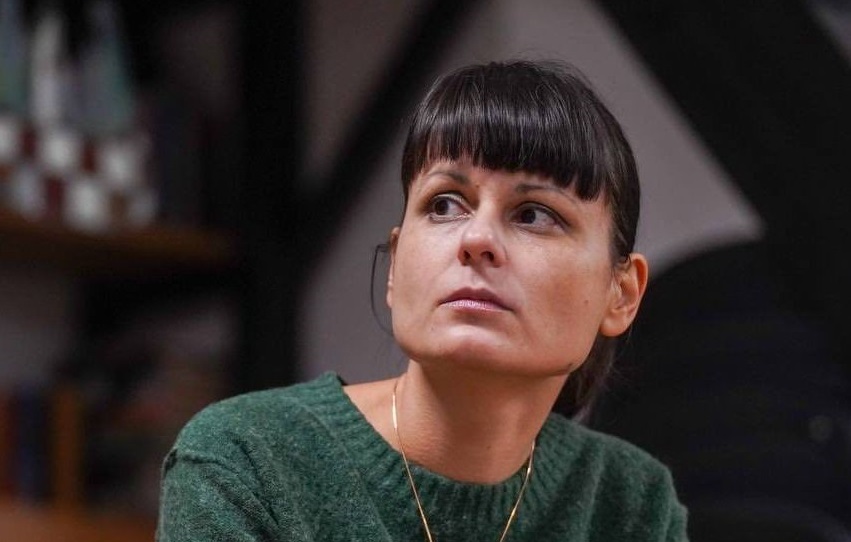
Featured Image: Yevhenia Henova.
Yevhenia Henova, an Odesa-based journalist, 03.03.2024


 Weltschau
Leave a comment