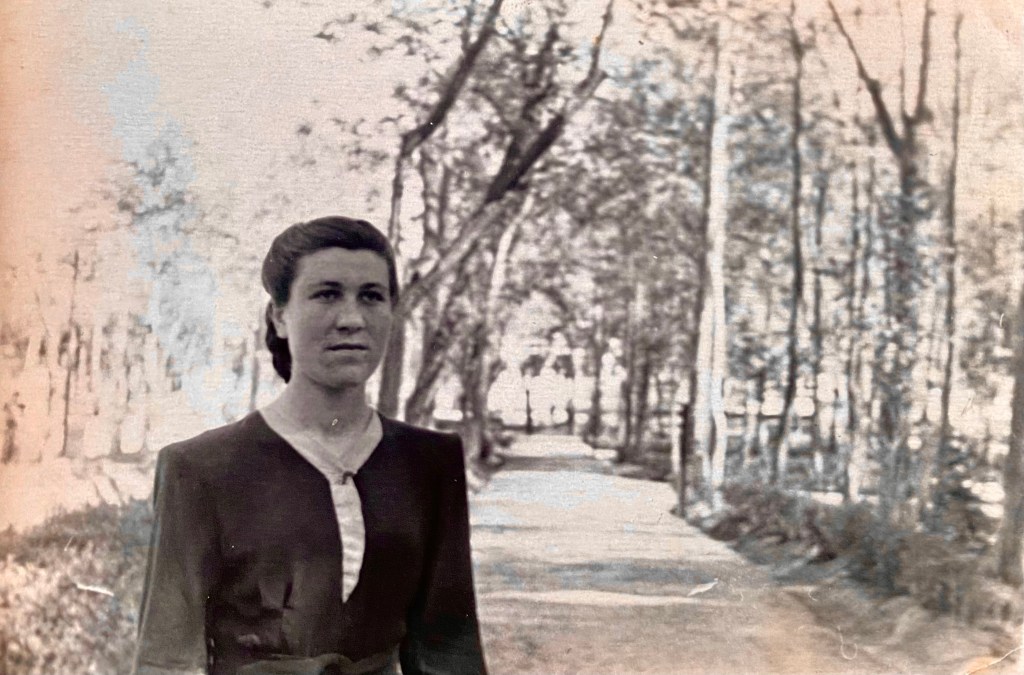
May 18, 1944, was definitely a black day for all Crimean Tatar people. No matter what geography they live in, when May 18 is mentioned, the first thing that comes to mind for members of our people is that terrible night of the deportation. It is not possible to forget, nor to forgive! This year, on the 80th anniversary of the deportation, I decided to tell you my family’s painful story of deportation, based on what my mother told me.
April 14, 1944, was the date Crimea was liberated from German occupation. There was a very joyful atmosphere everywhere because the war was about to end, there was literally a holiday atmosphere. The entire male population who joined the Soviet army and went to war was expected by their families to return happily, excluding those who lost their lives in the war. My mother, Sayde, painted and cleaned the whole house, put clean curtains on the windows, and was waiting for my father and uncles to return from the war. During the German occupation, we moved from our home in Alushta to Temirchi (Demirdzhi), located in the mountainous region, so that our family would be safe. At that time, we (my mother, me, and my younger brother Ayder) were staying at my mother’s uncle Ceppar’s house in Temirchi, and my grandmother Rebiya was staying in her own house next door with her little children. Our men had not yet returned from the war, and only women, the elderly, the disabled, and children remained in the village.
And that terrible night of May 18, 1944, came…
My mother (Sayde) was 34 at the time, I was 14, and my brother was 11. At 12 o’clock at night, there was a very loud knock on our door, and a voice shouting from behind: “Open the door quickly!” woke us up. When my mother opened the door without waiting, several soldiers burst into our house with rifles in their hands. “We’re giving you 15 minutes to pack up,” one of them said. Why, where, and what is happening? There were no answers to these questions. On the table were the gold jewelry that my mother took off every day before going to bed. One of the soldiers took them in one fell swoop and put them in his pocket. My mother, Sayde, seemed to be in shock, she couldn’t move or comprehend what was happening. That’s why we hurriedly got out of bed, put on our clothes, and went out to the azbar (garden) in fear. When we saw many soldiers with rifles pointing their barrels at us in azbar, we thought that they would definitely shoot us. My late grandmother, Rebiya, who lived in the house next door, was an agile woman. She took the letter addressed to the “mother of two heroic soldiers” and ran towards the commander. The thing is that my two uncles, Ceppar and Shukri, were two military officers who had been in the Soviet army since the first day of war and had many medals for heroism. And my grandmother showed the commander the letter of gratitude written by the commander-in-chief of the Soviet army units on the occasion of the liberation from the German invaders, “To the mother of two heroic soldiers,” and exclaimed: “I am the mother of two heroes, you cannot do this to me!” But the commander shrugged his shoulders, saying: “By the order of the Communist Party and the government, all Crimean Tatars are subjected to deportation, without exception.”
The gathering place was at the farthest point of Temirchi. In fact, a scheme like this was applied: they gathered the people living on the north side of the village in the south and the people living on the south side in the north so that they would stay away from their homes and not take so many things with them. We stayed at that gathering place for about a day. Some people were able to take some food and a few items with them, albeit in small quantities. My mother still hadn’t gotten over that shock. We were sitting there with our hands empty. Then a woman noticed this situation and begged the commander in charge, “Please allow this woman to go home and at least take a thing or two”. There were 5 more families in a similar situation, then the commander called out to a soldier: “Take the horse-drawn carriage and take them home, give them 5 minutes; let them get what they want; and come back quickly!” Our house was the furthest away; my mother was the last one left by the military. What is 5 minutes? My mother quickly threw flour, wheat, and a few other foods into the sack. When she came out, what did she see? There were no horse-drawn carriages or people outside. Everyone is gone. She returned home with sadness and only took with her the violin, which was of sentimental value to her, entrusted by my uncle Ibram before he left for the war and which he played very well, the photo album, a goose feather pillow, a very old teapot from an antique silver samovar dating back reportedly from the 14th century and, of course, a Holy Quran. Since there was no car, she had to leave the heavy sack full of food and clothes she had collected and walked back this long way on foot, crying. While my mother was walking, our dog, “Dezik,” tagged along behind her.
The next day, they loaded all the Crimean Tatars onto trucks (polutorka, a truck-like vehicle with an open cabin and rear end) and took them to the railway stations. Our beloved dog, Dezik, would not let go of the truck, once it even jumped into the cabin and then jumped into the back. My brother Ayder hugged his dog tightly and had no intention of letting go. The driver stepped in and said, “Son, leave your dog here; someone will feed it; no one knows where you will be taken; maybe those conditions will be difficult for it.” Even though it was difficult, my brother was convinced and left his dog. As the truck accelerated and continued on its way, our dog, with tears in his eyes, was running behind the truck. Everyone who saw this scene was crying, and tears were flowing from my brother’s eyes. Finally, our dog got very tired and gave up tracking.
On May 19, they started loading us into wagons carrying animals. There were 103 people staying in our wagon. Its tiny window was located close to the ceiling and had wire bars on it. Many people could not bear these harsh conditions and died from lack of air, hunger, and diseases. Three babies and three elderly people died in our wagon. When we crossed a river while the train was moving, the guards threw their bodies into the river. Some women were hiding the fact that their babies had died and were waiting for rare stops so that they could bury them. But it was very difficult because the stops were very infrequent, and usually the train arrived at the stops at night. At most, they could cover them with a few stones, but there were so many hungry dogs and wolves around that these precautions were insufficient, and the poor dead bodies easily fell prey to hungry animals. Many children got lost on the roads. Those who took some flour with them were trying to light a fire and make something similar to pita during short and infrequent stops. It was impossible to do this all at once, so they could only cook it little by little in a few stops and finally eat those pitas that were still half raw and fill their stomachs. The trains were crawling with lice and bedbugs, it was very difficult to bear it. At those rare stops, we children were trying to pick up stones and kill those insects. Salted fish were distributed twice. Of course, there was no water to drink. It was literally torture! At the stops, children were running in groups from wagon to wagon, looking for their lost families and relatives.
As we passed Melitopol, they started throwing stones at our train. They told the locals that “traitors” and “enemies of the people” were traveling on those trains. Thus, they pelted us with stones. One of the stones hit the head of 17-year-old Selime in our wagon. The girl lost a lot of blood. Even the captured German soldiers who worked on the railway tracks along the way were shaking their heads sadly, feeling sorry for us.
My paternal aunts were deported from Alushta. We had an acquaintance from Karasubazar who was working in the Alushta administration. One or two days before the deportation, he came to my aunt’s house at 10 at night and said: “We had a very strange meeting today. They warned the Crimean Tatars who returned from the war like us, one by one, and told us to stay around in the coming days and not to leave anywhere, and they even took a signature from us. I have a feeling something bad is going to happen.” The next day, they tore off the heroism medals and shoulder straps of all the officers who came from the war and were in the Alushta administration, disregarding their ranks, and loaded them into animal wagons along with our people and deported them from our Homeland.
Our family, namely my mother Sayde with two children (me and my brother) and my grandmother Rebiya with two children, were settled in the “Magadan” kolkhoz in the Kirov district of the Fergana region. There was a mandatory check-in once a month, and there was an obligation to sign. It was forbidden to leave the place of exile without notice! Those who violated and escaped were given a heavy penalty of 25 years in prison. The most difficult period of exile was the time we spent in the “Magadan” kolkhoz. First, they placed us in a small, two-room school that was used as a classroom. We were staying with several families in each room. With us was staying the family of Vacip Choban. One of his sons loved playing the violin. My mother, who learned this, gave our uncle’s violin to that child as a gift. Vacip Choban’s children were able to catch the hedgehogs, fry them, and feed themselves this way. We were all literally walking around hungry. I had the opportunity to taste hedgehogs once or twice. Once, a scorpion stung my mother at night, but thankfully it was not poisonous, and my mother survived. I will never forget the screams my mother made when she couldn’t stand the pain. If an adult in the family died and there was no any other adult nearby, the responsibility of burying was left to the children. Unfortunately, the children were having a hard time, they could only sprinkle a layer of soil on the corpses; they even left their clothes visible, they were underage, they had no strength; what could the poor things do! The place was swarming with jackals, of course they were destroying the graves. In the morning, we could only see bones around. It was a very painful scene. May God never let anyone experience this again!
There was a rice field in the kolkhoz. The water on the rice looked clean and transparent. We, the deported Crimean Tatars, were drinking from that water, and we were very surprised. Why were the locals not drinking from this beautiful-looking water, and they went and drank the dirty, muddy water from the aryk (small ditch-like channels dug on the side of the road). Of course, after a short while, dysentery, salmonellosis, etc. started to spread among our Tatars. When various infectious diseases broke out, we learned that a lot of fertilizer was used in the rice field, and although the water looked clean, it was very dangerous in terms of causing infection. Later, we learned that there was a well with artesian water in the neighboring kolkhoz, 3 km away from us, and we started going there. My mother, Sayde, was working in the cotton fields. I also often helped my mother. The heat of Central Asia is different; even in the shade, it was +50 degrees Celsius. There was neither a tree nor any other place with shade. It’s a completely open space. It was physically very hard work, and we were working in hellish heat, hungry, and thirsty. In return, we were getting extremely little money—something close to free.
When we first arrived, local people were skeptical of us. They were surely waiting for strange creatures to arrive because they told them scary things about us, and when our train approached, they were even waiting for us with stones in their hands. Even though we were so jolted on the road, when we got off, we looked very civilized. Over time, when they learned that our religion was the same, the coldness between us completely disappeared. Uzbek people are a hospitable people. One of our neighbors, an Uzbek woman with six children, would often make and give us pita bread, even though they were also starving. These kindnesses are unforgettable!
We were so hungry that sometimes, in order to earn a few cents, my grandmother, an agile woman, was telling the bean fortune. She was taking me with her, and we would go door to door with sticks in our hands against possible attacks by dogs. Sometimes we would return empty-handed, and sometimes we would earn enough coins to buy 1-2 slices of bread.
Later, our family took permission and moved to the “Posetovka” station in Besharyk, Fergana region. This was a more civilized and decent town compared to our old place. There were also in Besharyk large numbers of evacuated Jewish families, Leningraders (now known as Saint-Petersburgers), and wealthy Estonian families who had previously been deported. My grandmother Rebiya started to be paid a small amount of social aid because she was the mother of two soldiers. Our family—my mother Sayde, me, and my brother Ayder—were staying in a small house. My grandmother Rebiya and my aunt were staying in a small room at the entrance of her house, and my three aunts were staying with their children in the other room of her house. An Estonian family was staying in a small, one-storey house 150 meters away from our house. The woman was working as a seamstress, and her daughter Erika was a very beautiful girl. I loved her very much.
There was a school in Besharyk that provided education in Russian, and I finished the 7th grade there. In Besharyk, my mother found a job in a canteen and started working. The Akopov family, of Armenian origin, always helped us. Their daughter Seda was my classmate, and her father worked in the same canteen with my mother. We relaxed a little in those years; we were not hungry as before. There were decent people around us. But very sad and frightening events were also taking place. From time to time, three disgusting creatures named Startsev, Ramazanov, and Hayretdinov, members of the NKVD (after KGB, today FSB), would come to the canteen where my mother worked, eat, drink, and cause trouble, and make my mother pay for them. Sometimes they cornered her and squeezed her hands so hard that once she couldn’t stand it, and even the ring on her finger broke in half. This was about 1945–46. These disgusting monsters used the local “House of Culture” building as their interrogation room. They would call young women and girls for interrogation at night and do very disgusting things. There was a beautiful young Crimean Tatar woman from our neighbors who was a teacher; her husband had not yet returned from the war, and she was one of the victims of these monsters. One night, they had disturbed her so much, tortured her so much, raped her, and tortured her. She knocked on our door in the morning, covered in blood. She was in no mood to stand up; she was in a great state of collapse, both physically and psychologically. My mother tried to support her as much as she could, but her pain was so great that she could not bear this burden and soon committed suicide.
My father had just arrived from Trudarmiya (the labor army) around that time. Unfortunately, the NKVD’s methods never changed. First, they were intimidating and blackmailing people into writing denunciation letters called “donos”, letters full of lies and slander about the people they wanted. Then, they would arrest those innocent people, take them to the “famous” “House of Culture” for so-called interrogation, torture them, and make them take responsibility for crimes they never committed. Unfortunately, before we could get enough of my father, he was arrested as a result of a tip-off and taken to that known place for interrogation. I will never forget the screams I heard that night, my father, who was strong and brave as a rock, my only father, who was always very resistant to pain. They did it to my only father by breaking his bones, jamming his fingers in the door, and who knows what else. Finally, they imprisoned my only father, accusing him of serious crimes that he never committed. My father spent 11 years (1945–1956) for nothing; he suffered under harsh conditions in Magadan prison, one of the most remote places in Russia.
As I learned later, God’s punishment found those three creatures; one was run over by a train, one was killed, and one was left blind…
My uncle, Ceppar, returned from the war in 1947. My uncle was a military officer who won many medals in the war. He came to Besharyk and took our whole family, especially her mother, to Samarkand and helped us settle in. In Samarkand, we first settled in Koshkhovuz, the old city, close to the Siyob Bozor (Siyab market). I was hired as a secretary at school no. 10 in Samarkand. Thanks to the school’s principal, Uzakov, who always said, “Girl, you must complete your education, you are very curious and smart; attend seminars and classes with the university candidates who come to our school, prepare, and then you can take the exams.” That’s what I did: I worked hard and studied, successfully completed my high school education, and finally received my high school diploma.
In 1947, I wanted to apply to the Medical University (it was called the Institute of Medicine at that time). I really wanted to be a doctor. But they didn’t want to take my documents; I couldn’t register, and I was getting rejected all the time. Finally, the jury president, a woman, took me aside outside and said, “Look, girl, I feel very sorry for you; you seem very eager and curious to study, but what prevents this is that you are a Crimean Tatar. We have been instructed not to accept Crimean Tatars to the university. I have an advice for you, just between us, you can save the situation by changing your name. “Take a Slavic name, for example, and then the problem will be solved.” I was very enthusiastic, I was dying to study. I changed my name without telling my mother, and I decided to take the name of our beloved Estonian neighbor, Erika. This time, I registered without any obstacles and ran to give this happy news to my mother. But I encountered a reaction I never expected: “My child, what did you do? They are sending the first healthcare workers to the war; you chose one of the most dangerous professions, what if the war starts again, things are still messy. “You are my only daughter, what would I do without you?” she cried loudly. I loved my mother very much, and I couldn’t hate her. I decided to go and get my application documents back the next day. Vice-rector Tegeran Sergeyevich was very surprised when he saw that I wanted to take my documents back: “What happened to you? You were so eager to study, and now you give up?”, he asked me. I didn’t dare to tell him the truth and made up a little lie: “Since we will move to Fergana, I will apply to the Medical University there,” I said. When Tegeran Sergeyevich laughed and told me that there was no such university in Fergana, I turned red, apologized, and told him the real reason. There is nothing to be done, they gave my documents back. On the same day, August 31, 1947, I rushed to Samarkand State University (in those years, its name was Ali Sher Navai Uzbekistan State University) to apply to the Department of Philology. Exam weeks were over, but since the quota was not full, they registered me without much difficulty after a short interview. We were three Crimean Tatars in the philology department. There was one of the deans, Islamov Asan Mazinovic (who returned from war and was an associate professor), and a girl named Yulya Goldenberg in the class; her real name was Yulduz, and her surname Goldenberg came from her stepfather; otherwise, she could not enroll in the university. I was one of the first Crimean Tatars to study at the university. As soon as we registered at the university, the cotton-picking season started, and all school and university students were sent to pick cotton. I was the only student who resided in the city, and the other “city dwellers” showed their exempt slips (they obviously found a way not to go) and did not go. Those who went were students from other cities and villages in Uzbekistan. Those who came were very well equipped, they had camp beds (raskladushka), cushions, and food. I was the only one who came with the only clothes I had on; I had no bed, no pillow, and no food. I was in a very bad condition. Thanks to the girls, when we were going to sleep at night, they would put their beds together, share their quilts with me from both sides, and put me between them. My voice was so beautiful that girls always wanted me to sing. I often sang Crimean Tatar folk songs to them.
Thus, Uzbekistan gradually became our second homeland. We experienced many difficulties. As soon as my university years were over, they sent me to school in the town of Motrid for compulsory work. Regardless of the weather conditions, I had to cross that long, kilometer-long road on foot every day. There was neither a proper path nor any vehicle. Once, when the weather was very bad, I stopped a passing truck and begged the driver to let me go a little closer to Motrid. My joy was short-lived. Shortly after getting into the truck, we were stopped by the militsia (police) on duty. When they examined my ID and found out that I was a Crimean Tatar, they pulled me by my hair and threw me out of the vehicle rudely, and that day I went to my workplace crying. A 21-year-old girl suddenly became the classroom teacher for high school students. Our age difference was about 4–5 years. The Tajik population was predominant in Motrid town. The students were speaking Tajik among themselves, and in a very short time, I began to understand that language and then use it comfortably. My students loved me very much. I would often tell them about my beautiful homeland, Crimea, the sea, and the mountains, and I could not help but cry when I told them about my hometown. Sometimes the children would ask, “Teacher, if one day the borders were opened and you were allowed to return to Crimea, would you go?” My answer was always the same: I would go barefoot, on foot, even if it took months. My first graduates were my pride; almost all of them continued their education and reached high positions. Our friendship with some of them continued for life.
After 1967, Crimean Tatars were allowed to visit Crimea as tourists on the condition that they did not settle there. What a sad truth, we could only go to our own homeland as tourists. Every name we know in our beautiful homeland has been changed, and attempts have been made to give the false impression that Crimean Tatars never lived there. It was very painful to see that beautiful Crimea filled with foreigners, to see those foreigners who took over our home, our childhood, our memories, our history, and our past. This separation lasted nearly 50 years, and I missed my homeland very much. In the end, we came together, even though we were penniless and under harsh conditions. We rebuilt our lives, for better or worse. I hope they don’t make us experience this exile again.
***
Oh, mom, how wrong you were! We are experiencing the continuation of this nightmare today. That longing is on the tip of our lips again, and the desire to reunite with our beautiful Homeland is beating loudly in our hearts again. Our people are still wandering around on the roads, scattered all over the world. Our citizens are being imprisoned again, and our country is under occupation again. But know that the Crimean Tatar people, who are fond of their freedom, will definitely not disappear. We are strong, we are brave, and we will get through these days.


 Weltschau
Leave a comment